Gutter Cleaning in Waterloo, Ontario
Eavestroughs cleared by hand, downspouts unblocked and tested, guards fitted on the big-lot streets where the trees justify them, and maintenance plans built for landlords with student houses who would rather not hear about the gutters from a tenant. One insured local crew across Waterloo and the Woolwich villages.
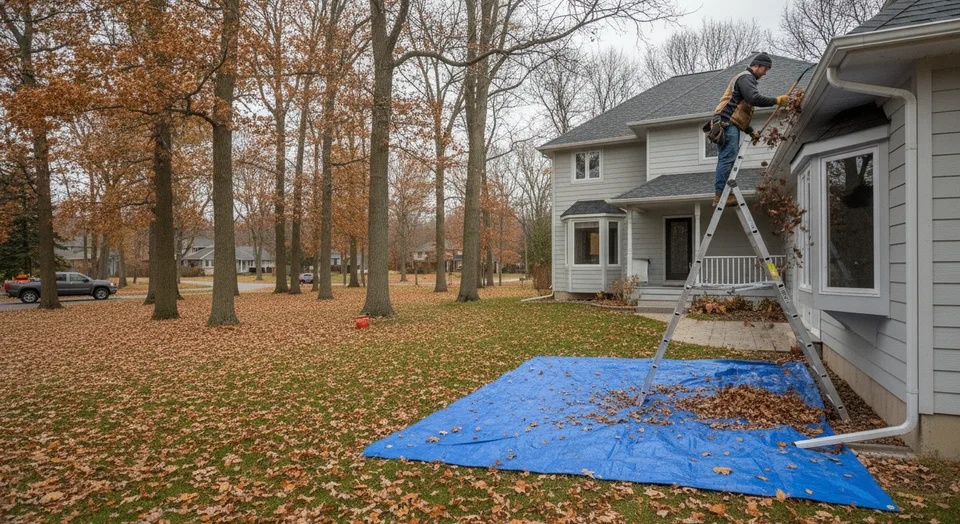
Waterloo's gutters come in three kinds. On the big lots of Beechwood, Lakeshore and the Westmount streets, the houses sit back under trees planted in the 1960s and 1970s that are now at full height, the roofs are long and the eavestroughs are far from the road and often far from level ground, which makes the work slower and the guards more often worth it. In the university district, from Northdale across to the streets off Albert, Columbia and University Avenue, the housing is older and rented, nobody living there owns a ladder, and the person responsible for the gutters lives somewhere else and finds out about them when a basement tenant mentions the damp. And in Laurelwood, Vista Hills and the newer west side, the trees are still young, the troughs fill with grit rather than leaves, and once a year is honestly enough. This is the booking line for one vetted, insured gutter cleaning crew that works across all three: hand-clearing the troughs, flushing every downspout to the outlet, checking that roof water lands on grass and not on the neighbour's side of the line, and fixing the seam or the sag while the ladder is up. Quotes are written after a look, not guessed from the street.
Gutter Work We Take On in Waterloo
Eavestrough cleaning, downspout unblocking, gutter guards fitted to existing troughs, small reseal and re-hang repairs, and maintenance plans for homeowners and landlords. Cleaning and upkeep only; replacement and new installation belong to an eavestrough installer.
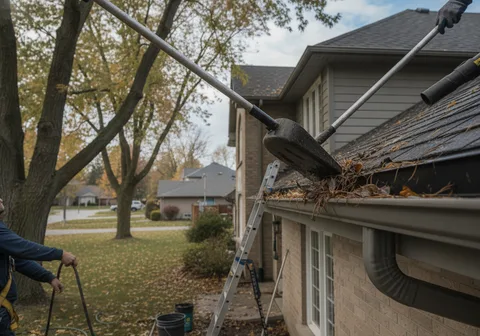
Eavestrough Cleaning
Long runs cleared by hand from a stand-off ladder, roof edges and valleys pulled clear, every downspout flushed, and photos of each run sent to you or to the owner.
Learn more →
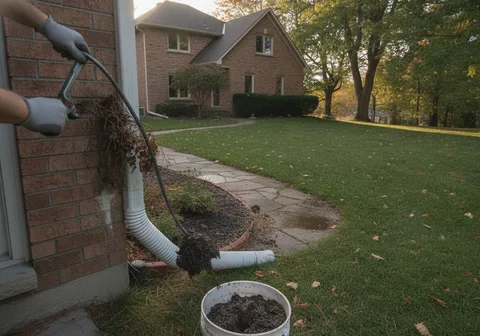
Downspout Unblocking
Every downspout flushed and watched at the outlet, packed elbows opened, underground runs tested for backup, and each discharge checked against where the City expects roof water to go.
Learn more →
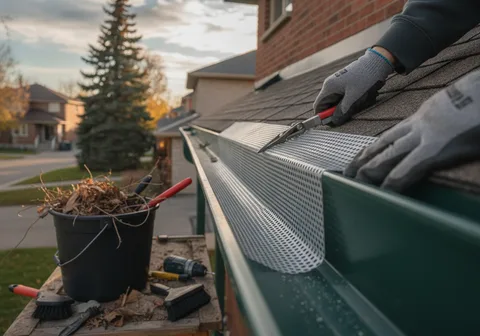
Gutter Guards
Guards specified to what is over your roof, fitted to the troughs you have, recommended where a tree or an absent owner makes them pay, and declined where they would not.
Learn more →
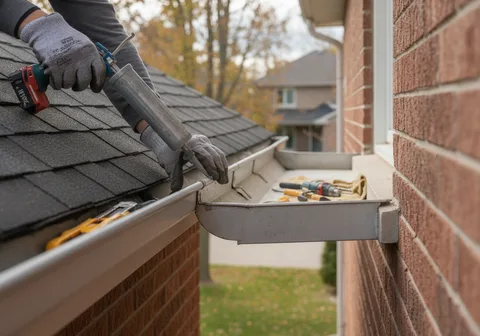
Small Gutter Repairs
Weeping seams and end caps resealed, backed-out spikes swapped for hidden hangers, a short run re-pitched to drain, and downspouts and extensions reattached, all quoted before they are done.
Learn more →
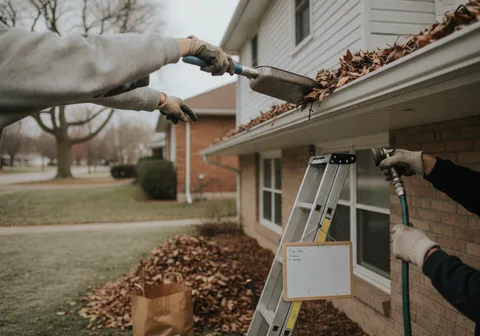
Maintenance Plans & Landlord Service
Fall-and-spring or fall-only plans booked ahead, plus a landlord service for rental houses: discharge checked against the by-law every visit, photos to the owner, a courtesy notice to tenants, no contract term.
Learn more →
Gutters in Waterloo: Big Lots, Student Houses and the Stormwater Bill
Beechwood, Lakeshore and the long roofs under old trees. The neighbourhoods Waterloo built through the late 1960s and 1970s were laid out generously: wide lots, houses set well back, long low roofs on ranches and side-splits, and trees planted at the same time that have had fifty years to grow over them. Beechwood off Fischer-Hallman, Lakeshore north of Northfield and the Westmount streets are the clearest cases. A long roof means a long run of trough with several downspouts, and a tree over it means that run fills every fall and often again in spring with maple keys. The ground under the eaves is landscaped rather than flat, so ladder placement is slow and careful. These are the Waterloo houses where guards most often pay back, where a two-visit plan is the norm, and where a downspout discharging onto a neighbour's lawn or a shared side yard is a property standards matter as much as a drainage one.
The university district: gutters nobody who lives there is going to clean. Northdale, the streets off Columbia, Albert and University Avenue, and the older houses on the Laurier side of uptown hold a large share of Waterloo's student rentals, and their gutters have a specific problem: the people living under them do not own the house, do not own a ladder and will not call about an overflowing eavestrough until water is in the basement unit. The City of Waterloo requires a rental housing licence for long-term rentals of a house, duplex or townhouse, renewed annually, and its property standards by-law covers directing roof drainage away from neighbouring properties, sidewalks and roadways and preventing water from damaging buildings. A landlord who gets a complaint about a downspout pouring onto the sidewalk or the next lot has a by-law matter, not just a maintenance one. The practical answer is a plan: scheduled visits, downspouts tested, discharge checked, photos to the owner, and the tenant told the date as a courtesy.
The stormwater credit, and what a clean downspout has to do with it. Waterloo bills a stormwater fee on the utility account, and the City offers a residential stormwater credit of up to 45 per cent of that fee for owners of a single home or duplex who capture or soak away rainwater on the lot. The tiers are by litres captured: 9 per cent for 200 to 500 litres, 18 for 501 to 1,000, 27 for 1,001 to 2,100, 36 for 2,101 to 2,260, and 45 at 3,361 litres and above. Rain barrels and cisterns must hold at least 200 litres, connect securely to a downspout and overflow onto grass or garden rather than pavement. Infiltration galleries and soakaway pits take downspouts routed straight in, must sit at least five metres from the house, and the City's own guidance recommends gutter guards on troughs feeding them so the pit does not silt. Applications are currently taken by email and mail only. Every one of those measures depends on a downspout that runs clear and a trough that is not dumping leaves into the barrel or the pit, which is why the credit and the gutter clean are one project from the roof's point of view. The crew fits barrel diverters on request; the application and the approval are the City's.
Freeze, thaw, repeat: the normals and what they do to a full trough. Environment Canada's climate normals for the Region, from the airport station, give December a mean daily high of 0.2 °C and a mean low of -6.8 °C, with March at 3.6 °C over -5.6 °C. The Region averages about 160 cm of snow a year, has snow on the ground on roughly 95 days, and sees freezing rain on about ten. That is a climate built for ice dams: afternoon sun and a warm attic melt the roof snow, it runs to the cold eave, and it freezes in the trough overnight. If the trough is already half full of wet leaves the dam forms faster and higher, meltwater backs under the shingles, and the result is the brown ring on a bedroom ceiling in February. A plugged downspout freezes into a column and can split at the seam. Dams are ultimately an attic insulation and air-sealing problem, but an empty, draining eavestrough is the cheapest defence, and in Waterloo that means the fall clean landing in the second half of November.
Who should not be on the ladder, and the rules that say so. Picture the back of a Lakeshore two-storey: the eave is roughly six metres up, the gable peak higher, and below it is a sloping lawn, a planting bed, a window well and the air conditioner. Now picture a tenant who was asked to have a look, or an owner with a borrowed extension ladder. Ontario treats that height seriously when it is a worker: the Construction Projects regulation under the Occupational Health and Safety Act calls for fall protection wherever a worker could fall more than three metres, and O. Reg. 297/13 makes ministry-approved working at heights training, refreshed every three years, mandatory for construction workers who may rely on it. The crew this site books carries that training and the stand-offs and ladder levellers that go with it. A homeowner or a tenant carries none of it, and for a landlord there is an extra reason to keep tenants off the ladder altogether: a fall on your property is your problem long after the gutters are forgotten.
What leaves the property, and how. Several bags of wet leaves and roof grit come off a treed Waterloo house in November, and the Region of Waterloo has rules for where they go. Yard waste is picked up every other week, on the week garbage is not, from late March until the end of November or the start of December. It has to be in paper yard waste bags or in an open rigid can of under 121 litres with two handles and no lid; plastic bags are refused, and each bag or can is capped at 23 kg (50 lb). Gutter debris is bagged to that standard and either set at your curb for the next yard waste week or carried off. Separately, the City of Waterloo runs an optional loose leaf pickup that is only for the leaves of the street trees on your boulevard, zone by zone over four weeks between late October and late November, with leaves raked to the curb a few days ahead and kept clear of storm drains, sidewalks and bike lanes. It is not a route for what comes out of an eavestrough. The Region's drop-off on Erb Street takes what misses both, and once the seasonal yard waste pickup stops, anything left is garbage and counts against the bag limit, so the November finish matters for the debris as well as the ice.
Serving Waterloo & Surrounding Areas
Waterloo's residential stormwater credit tiers, qualifying measures and application route are set out on the City of Waterloo stormwater credit page; roof drainage and grading obligations are summarised on the City's property standards page; rental licensing on its residential rental licences page; and the optional loose leaf program in the City's leaf collection notice. Yard waste container, weight and schedule rules are the Region of Waterloo's. Temperature, snowfall and freezing-rain figures are Environment and Climate Change Canada 1981–2010 climate normals for the Waterloo Wellington A station. Fall protection and working at heights rules are in O. Reg. 213/91 and O. Reg. 297/13 under Ontario's Occupational Health and Safety Act. Whether a measure qualifies for a stormwater credit, and whether a given property needs a rental licence, are the City's determinations.
Frequently Asked Questions
How often should Waterloo gutters be cleaned?
Twice a year on the treed big-lot streets of Beechwood, Lakeshore, Westmount and the older uptown blocks: late November after the leaves, and late spring for the keys and grit. Once a year on the newer west side in Laurelwood and Vista Hills where the trees are young. Student rentals in the university district are usually best on a scheduled plan so the question never depends on a tenant noticing.
Do you clear the downspouts as well?
Always. Each downspout is flushed from the trough with the hose running until clear water comes out the bottom, rodded or opened at the elbow if it does not, and tested for backup if it runs underground. A clean trough over a plugged downspout fails in the first rain.
What does gutter cleaning cost in Waterloo?
It is priced on the house: height, length of trough, how many downspouts and their condition, what is over the roof, and the ground under the ladder. Planning ranges are on the cost page, and the firm number is written after a look at the house or at clear photos of each side.
Can a rain barrel reduce my stormwater fee?
The City lists a 9 per cent credit for capturing 200 to 500 litres, which a single barrel of at least 200 litres connected to a downspout can reach, rising through tiers to 45 per cent for large cisterns or infiltration systems. The barrel must connect securely and overflow to grass. The crew will fit a diverter; the application goes to the City by email or mail and the decision is theirs.
I own a student house. Can you deal with the gutters without me being there?
Yes, and that is what the maintenance plans are built for. The crew needs an outside tap and access to the yard; the tenants get a courtesy notice of the date; the photos and invoice come to you. A downspout pouring onto the sidewalk or the neighbour's lot is a property standards issue as well as a maintenance one, so it is checked on every visit.
Are gutter guards worth it on my house?
On a Beechwood or Lakeshore lot with a mature tree over a long roof, usually yes. On a Laurelwood house with a sapling on the boulevard, no. The type matters as much as the decision: maple keys and spruce needles defeat cheap mesh. You get a plain recommendation, including guarding only the one run that always fills.
Can you fix a leak or a sag on the same visit?
Yes, as a small repair quoted before it is done: resealing a seam or end cap, replacing backed-out spikes with hidden hangers, re-pitching a short run, reattaching a downspout. Replacing runs of eavestrough, new installation and fascia or soffit work are an installer's job and are not done through this site.
Do you work in winter?
Not on frozen troughs. A gutter full of ice cannot be cleared safely and a ladder on ice is not something the crew will climb. A January call about an ice dam gets honest advice about managing the melt and the first open booking in spring; the November clean is what prevents the next one.
Ready to Get Started?
Call 289-672-4041 or send the form for a written quote for gutter cleaning in Waterloo.